
A look back at some events from late 2025, which the erratic (or almost non-existent) updates of the networks and other concerned sites didn’t really help to highlight…
In November, I nonchalantly took advantage of a short stay in Eastern France to, with good grace, make a fleeting appearance at the latest edition of the Augenschmaus creators’ market, which was held on Sunday, November 16, at LUCA (Luxembourg Center for Architecture). It was nice… but also a good thing I hadn’t traveled specifically for the occasion.
The desire to be elsewhere had been felt for some time…
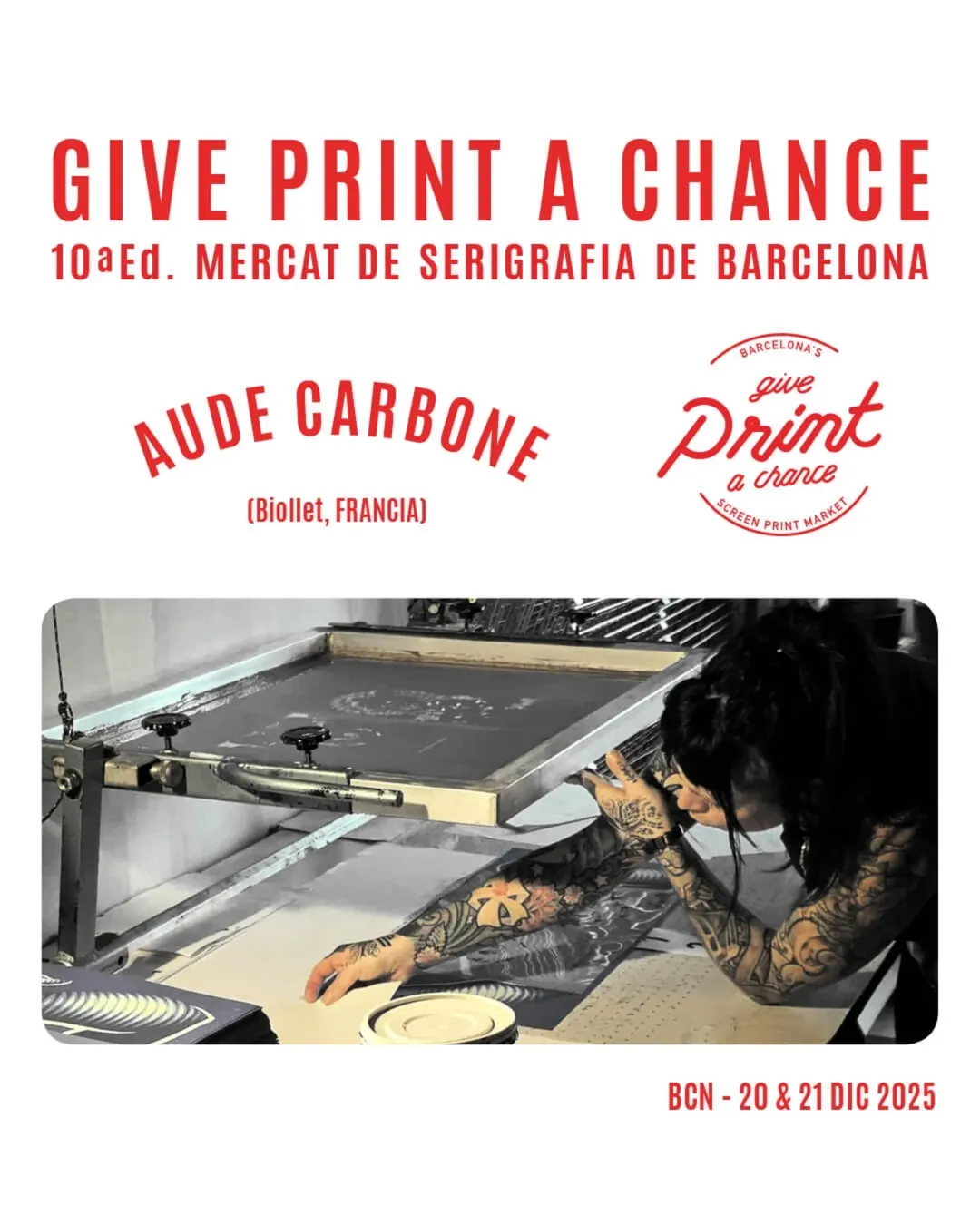
In December, I finally responded positively to Alex’s invitation –from the Print Workers Barcelona workshop– who had been urging me for 3 years to come and occupy a table at his event dedicated to local and international screen printers:
Give Print A Chance – the weekend of the 20th and 21st in Barcelona (Spain).
My last trip to Barcelona was eighteen years ago (!) when I was still just a little child… no, I’m kidding, I was in my fresh twenties and the Sagrada Familia wasn’t consecrated yet, so it hadn’t become the money-making machine it is now:
it would have been simpler to take a plane to the USA with a briefcase full of Anthrax than to visit this cathedral (and depending on the airline, almost cheaper!!!).
Speaking of economy, for the sake of the budget – and for science – we experienced the round trip by bus. So, positive point: I will have better memories of this bus epic than of the same train journey 18 years ago.
Notably because my seat at the time was in front of a bunch of overexcited teenagers, which prevented me from getting any sleep the entire trip (says the Old Lady). And it must be said that in 20 years, the comfort of seats in transport has improved.
Barcelona is a city where it is certainly much more pleasant to be a tourist than a resident, and that is why I always remain quite ambivalent (even “lukewarm-cold”) about must-see destinations: I would like to know the percentage of individuals who are aware and respectful of the place they are going when they set out to discover.
For years, moving in all directions, frequenting fairs, festivals, and exhibitions, I have had the opportunity to pass through (sometimes despite myself) so-called tourist places, and it’s always the same bitter observation: People seem to be there more to tick the box “done that,” take an Instagrammable selfie they can post on their networks, just as we used to send postcards with eroded landscapes (due to flashes) without even looking with their [real] eyes at what they are capturing on their phone.
From the summit of Puy de Dôme – in the middle of a chain of volcanoes in Auvergne – where an unusual tourist complex has sprung up (souvenir shop, cultural information, local food, small train for the lazy, unforgettable viewpoint for your digital photo album that you will never consult…), passing through museums and their anti-UV glass on the exhibited paintings (I would like to compare the number of photos taken per day of the Mona Lisa, and the number of people who could say from memory what is in the background of the same painting, or even if they remember ever setting foot in the Louvre), or even Everest where the waste (when not the dead bodies) of tourists who climb there in single file and form other kinds of small mountains, because conditions do not allow for “clutter” (pardon the expression).
Or cities like Venice, where a tax is now imposed on tourists (phew!) who nevertheless outnumber residents (argh) and whose tireless density threatens the city’s ecology.
I would like to add Barcelona to this list, and although I cannot deny the aesthetic and historical appeal of the city, I retain the feeling of having added myself to this long list of passers-by and other curious individuals who, through a mass effect, transform locals into zoo animals, and generate the fertilizer that makes tapas bars and souvenir shops grow faster than couch grass.
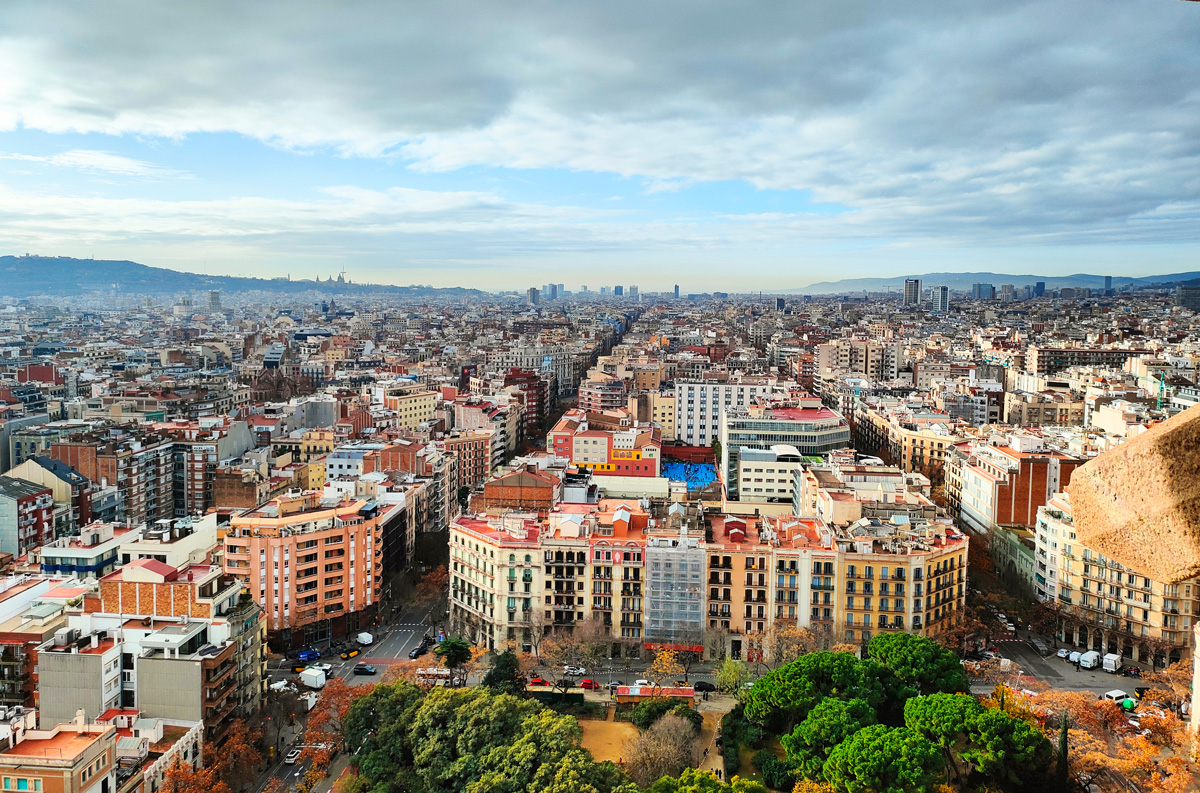
In conclusion, what authenticity remains in these places, ravaged by millions of photos, millions of footsteps, millions of rubbings, architectural rearrangements that do not stem from a practical need of the locals, but from a logic of commercial development aimed at attracting ever more tourists, and which ultimately crush what responded to the daily lives of the inhabitants?
Escaping from home should be a pure act of discovery, rooted in a logic of respect and integration into the place and among the individuals within which we infiltrate for a few days… or several months.
What remains to be seen of something that has been seen so much that it loses its nature? I am tempted to compare this phenomenon to the morbid voyeurism that consists of watching with unhealthy contentment other individuals agonizing (with maximum suffering) while sipping a Mojito bought for a fortune at the hastily built refreshment stand on the ashes of the house of the
tortured person. (Watching snuff movies while gorging on peanuts falls into the same category). The problem is not that several people want to go to the same place to enjoy an environment that will disorient them; the problem is the massive fashion phenomena which, just as they sterilized originally rebellious underground musical movements (rock in the late 60s / early 70s, techno in the late 80s / early 90s, etc.), reshape picturesque spaces into sanitized shopping malls. And what is appalling is that no one (or too few people) seems to grasp the bug in the equation.
Tourism has replaced adventure. Capitalism has made comfort its lubricant.
I’ll stop this overly long digression here, but sharing this point of view seemed important to me. The publishing fair itself was good-natured, Print Workers Barcelona workshop is a place I invite you to visit if your path takes you to that area: the space is huge, screen printing there is 100% artisanal, and I was delighted to be reunited for these few days with this small island, the opposite of a tourist spot..

